Home The Discipline Books For Readers Work With Me In Practice Insights About Schedule a Session

Intent Management™

AI Moves Fast.
Leaders Set
the Direction.

Most AI adoption fails quietly — not from bad technology, but from unclear intent. Intent Management™ is the leadership discipline that keeps humans and AI working toward the same outcome.

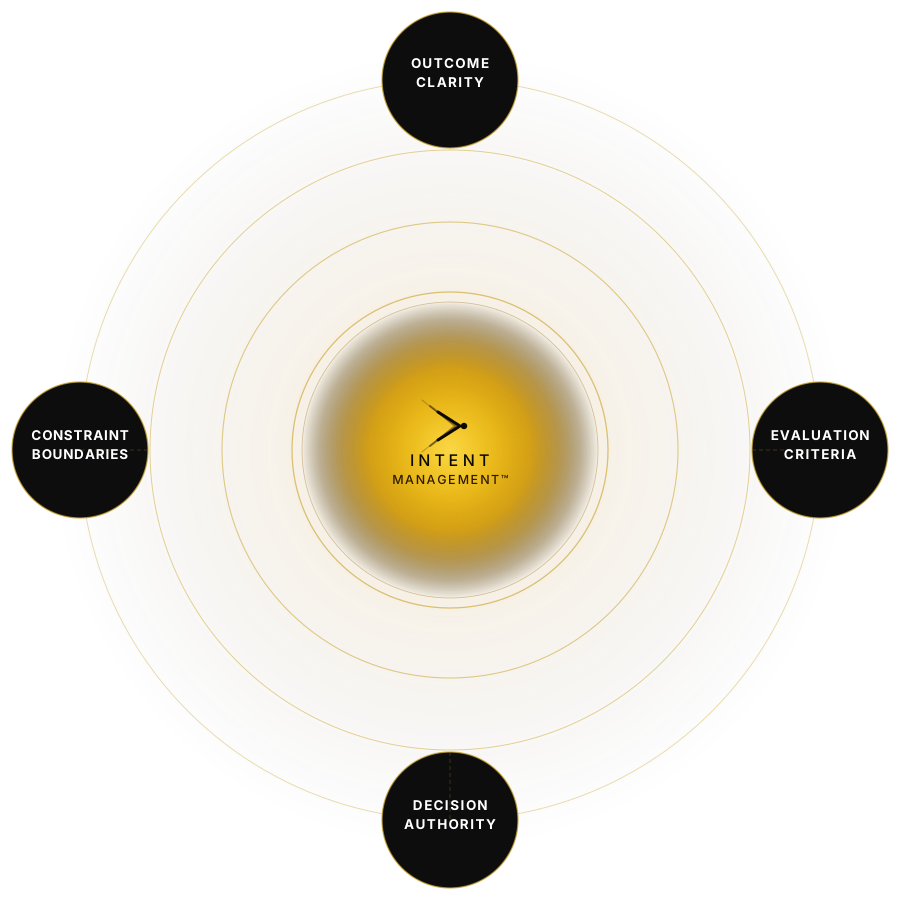
Intent Management™ orbital diagram — four elements: Outcome Clarity, Evaluation Criteria, Decision Authority, Constraint Boundaries
The Core Problem

Teams are deploying AI tools without defining what success looks like, who decides when output is good enough, or how to course-correct when the work drifts. That's not a technology problem. It's a leadership problem.

The Discipline

What Is Intent Management™?

Intent Management™ is a structured approach to leading AI-enabled work. It gives leaders a way to communicate expectations clearly enough that AI systems and the humans working with them can produce consistent, high-quality outcomes — without requiring constant supervision.

The framework has four elements. Together they define what good work looks like, who evaluates it, who decides when it's done, and how the team stays calibrated over time. When all four are operating, AI adoption stops being a gamble and starts being a practice.

Developed from research and real-world implementation with leadership teams across industries, Intent Management™ is practical by design. It doesn't require a transformation initiative. It requires leaders willing to be explicit about what they actually want.


Learn the Discipline →

01

Outcome Definition

Clarity about what success actually looks like before the work starts.

02

Evaluation Criteria

The specific standards used to judge whether output is good enough.

03

Decision Authority

Explicit boundaries around who approves, adjusts, or overrides AI output.

04

Constraint Boundaries

The limits that cannot be traded away regardless of competing priorities.
Self-Assessment

Find Your Breaking Point

When AI-enabled work goes sideways, the cause almost always traces back to one of four places. Eight questions. About sixty seconds. You'll know exactly where to focus.

Question 1 of 8

Question 01

The Books

Read the Work

Alignment at Speed — Leading AI-Enabled Teams by Keith Johnson New Release

Alignment at Speed

Leading AI-Enabled Teams

AI is changing how work gets done — but most leadership frameworks were built for a world where humans produced every output. This book provides a practical model for leading when AI is doing significant portions of the work.

Alignment at Speed walks through the Intent Management™ discipline in full: how to define outcomes precisely, how to set evaluation criteria your team can actually use, how to structure decision authority in human-AI workflows, and how to keep communication tight enough that intent doesn't drift.

Written for leaders who are already dealing with AI adoption and need a framework that works in the real world — not a theory built for a future that hasn't arrived yet.

Shifting Into Leadership by Keith Johnson

Also by Keith Johnson

Shifting Into Leadership

Daily Habits that Build Clarity and Trust. The field guide for new managers navigating the shift from individual contributor to team leader. Practical habits, hard truths, and a clear path forward for the first ninety days and beyond.

Buy on Amazon →

Work With Me

Engagements

Every engagement is built around one goal: helping leadership teams get clear on their intent so AI adoption delivers real results. Available as keynotes, workshops, and working sessions.

Light beam expanding

In Practice

Intent Management™
in the Real World

How organizations across industries apply the discipline when AI-enabled work gets complex and the stakes for getting it wrong are high.

Leader standing still while the world moves fast

Medical Devices

When Tolerance Is Not a Number

A hearing aid manufacturer was 18 months into development when regulatory, hardware, and AI research teams were all working toward different versions of "done." Here's how that got resolved before it became a missed submission date.

Read the case study →

Automotive

The Right Answer Was Already There

Three teams building the same EV display platform from different directions for 14 months — until an AI design tool produced 40 non-compliant UI variants six weeks before integration lockdown.

Read the case study →

Enterprise HR Technology

Six Systems, One Source of Truth

Four executive sponsors co-owning an HRIS consolidation had never established whose requirements governed when they conflicted. An AI architecture tool was recommending integrations the CISO would have rejected.

Read the case study →

Hospitality & Construction

The View From the Water

A fixed budget, a set opening date, and a historic preservation society whose requirements the AI scheduling and cost estimation tools didn't know about. The scheduling tool was protecting the wrong variable.

Read the case study →

Insights

From the Blog

Why AI Adoption Fails Without Clarity

Most organizations deploy AI tools before they can answer a basic question: what does good output look like? When that definition is missing, teams spend more time correcting AI work than benefiting from it.

Read more →

The Human Side of AI Adoption

Resistance to AI is rarely about the technology. It's about identity, autonomy, and trust. Leaders who understand that get much further than those treating it purely as a change management exercise.

Read more →

Which Element of Intent Management™ Is Breaking Down?

When AI-enabled work goes sideways, the cause is almost always one of four things. Knowing which one tells you exactly where to focus the fix.

Read more →

Ready to Lead with Intent?

Whether you want to read the book, bring a workshop to your team, or talk through a specific challenge — the best place to start is a conversation.

Schedule a Session